 Shutdown Circuit
Reversed power-supply connections are a real risk in the field. A connector may be assembled incorrectly, or an errant mistake while bench testing a design with bare wires can apply reverse voltage to a board and destroy unprotected ICs instantly.
| Variant | V drop | Best for |
|---|---|---|
| Series Diode | 0.3–0.7 V | 12 V inputs and simplest implementation |
| P-ch MOSFET: Gate to GND | Minimal voltage drop. safely within (typically 12 V systems) | |
| P-ch MOSFET: Zener Clamp | Minimal voltage drop. approaches or exceeds (24 V systems) |
Series Diode
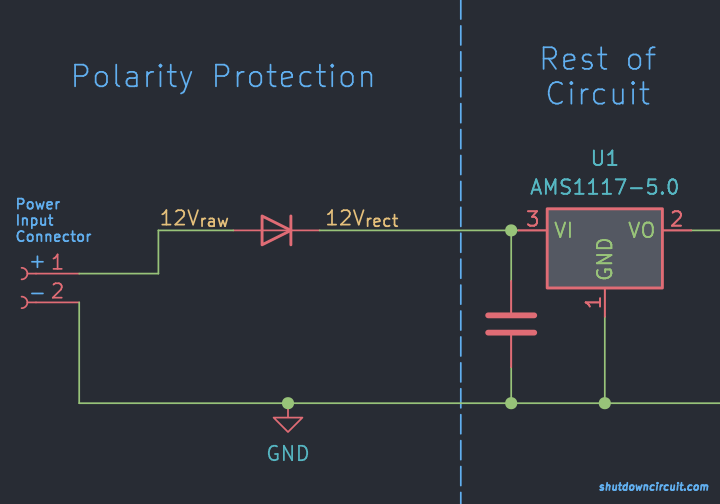
Honestly, the best choice 9 times out of 10 in a FSAE context. Place a Schottky diode in series with the positive supply rail, anode toward the source, cathode toward the load. Under correct polarity the diode conducts; under reverse polarity it blocks.
Suitable for applications where some voltage drop is acceptable, for example a 12 V input that immediately regulates down to 5 V or 3.3 V. Use a Schottky diode to minimise voltage drop and heat.
P-channel MOSFET: Gate to GND
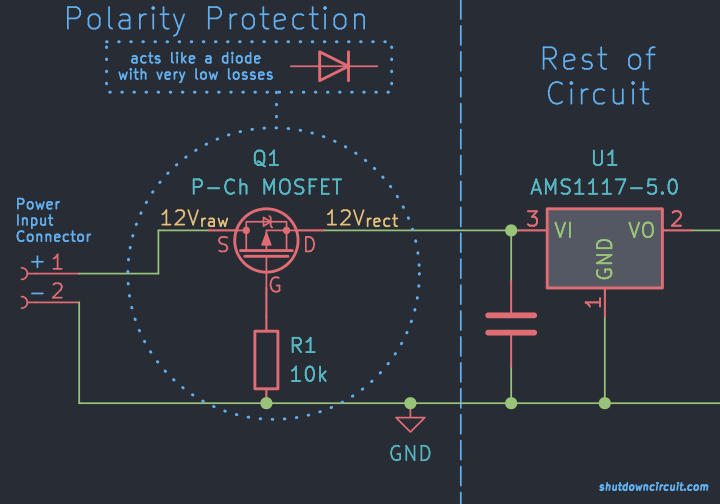
Q1 is placed in series with the positive supply rail, source facing the input, drain facing the load. The gate is connected to GND through R1 (10 kΩ to 100 kΩ). Under correct polarity is negative, Q1 turns on and passes current to the load with a drop of only . Under reverse polarity becomes zero or positive and Q1 stays off.
The body diode of Q1 faces in the same direction a simple Series Diode would. Under normal polarity it could forward-conduct, but with Q1 fully enhanced the channel conducts preferentially and the body diode stays below its forward threshold. Under reverse polarity R1 pulls positive and ensures Q1 stays off; the body diode resists reverse current.
Suitable for supply voltages where the full rail is within the MOSFET’s rating. On a 12 V system with a rated device this is typically fine. On a 24 V system, use the zener clamp variant instead.
P-channel MOSFET: Zener Gate Clamp
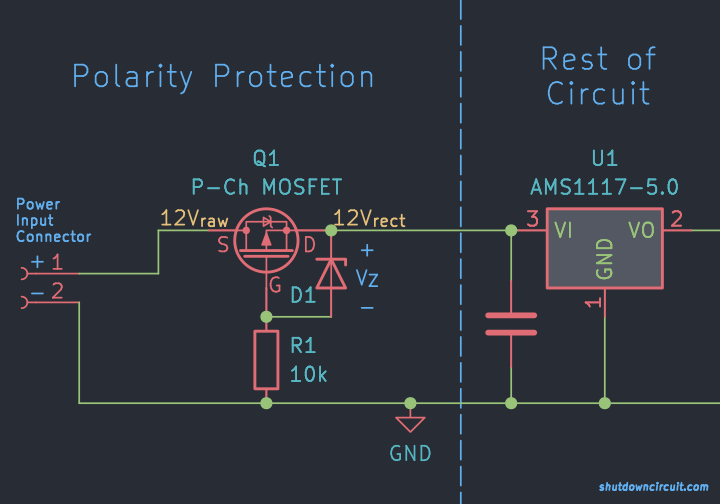
Use this variation for applications where supply voltages approach or exceed the MOSFET’s . Zener D1 is added between the gate and source terminals, with its cathode at the gate. R1 (1 kΩ to 10 kΩ) sits in series between the gate and GND. Under normal polarity:
- The source sits at .
- The gate is pulled toward GND through R1, and D1 clamps at , the reverse breakdown voltage of the zener.
- , must be sufficiently negative to fully enhance Q1.
The zener limits to . Choose a zener voltage such that stays within the rating across the full supply voltage range. For a 24 V rail with a DMG2305UX MOSFET rated , a 14 V zener limits to 17.2 V.
Design notes
- Pick the simple Series Diode option most of the time. The MOSFET solutions only make sense if you:
- expect high currents >3A;
- need to minimise heat dissipation (in which case they wouldn’t be driving a linear voltage regulator - as in these examples), or;
- must keep voltage drop absolutely minimal. For this case it might be worth reconsidering your downstream circuit design. This requirement could be a symptom of a ‘brittle’ downstream circuit.
- : The gate threshold must be compatible with the supply rail. Most P-channel MOSFETs are fully enhanced at or . Ensure is well above threshold across the minimum expected supply voltage.
- absolute maximum: Tying the gate directly to GND on a 24 V rail applies 24 V across the gate, which exceeds the rating of most MOSFETs (commonly to ). The zener clamp is mandatory in this case.
- Zener selection: A 5.1 V to 10 V zener suits most 12 V to 24 V supply applications. The zener power dissipation during normal operation is low because R1 limits current through it; verify it is not exceeded.
- and power dissipation: At high currents the conduction loss becomes significant. For 10 A through a 20 m MOSFET, . Check the junction temperature and package thermal resistance.
- Gate resistor R1: Prevents the gate from floating during transients. In the gate-to-GND configuration it also limits gate charge current. Values of 10 kΩ to 100 kΩ are typical. You might use 1 kΩ to 10 kΩ in the zener clamp configuration to allow faster gate charging if necessary - verify power dissipation is acceptable.
Gotchas
- Do not orient the MOSFET with the drain facing the input. The body diode would then conduct under reverse polarity, providing no protection at all.
- In the gate-to-GND configuration, the full supply voltage appears across the gate. On a 12 V system this is probably fine; on a 24 V GLV system it will destroy MOSFETs with a gate rating if the supply ever spikes. Use the zener clamp on any 24 V design.
- This circuit protects against a sustained reverse connection. It does not protect against a brief negative transient spike on an otherwise correct supply. Pair with a TVS at the input for transient protection.