 Shutdown Circuit
Overview
A voltage divider is a resistive network that produces an output voltage equal to a fixed fraction of its input. Two resistors in series across a supply form the divider; the output is tapped between them. It is one of the most fundamental circuits in electronics.
In a FSAE, voltage dividers appear wherever a voltage is measured by a low-voltage circuit, a signal must be level-shifted before entering an ADC or comparator input, or for scaling a 5 V sensor output down to the 3.3 V range of a microcontroller ADC. They also appear in high-voltage measurement circuits, where the TS bus voltage (200–600 V) must be reduced to less than a 5V-level signal for monitoring - as in the Precharge.
Circuit description
R1 connects from the input to the output node. R2 connects from the output node to ground. Current flows from through R1 and R2 to ground; the output voltage is the voltage developed across R2.
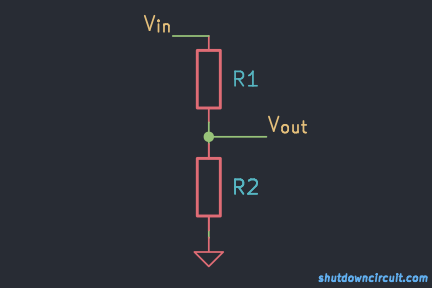
The output voltage is:
Worked example - scale 5 V to 3.3 V:
With R1 = 10 kΩ and R2 = 20 kΩ, the divider ratio is 20/(10+20) = 2/3. At = 5 V, = 3.33 V. This is a useful starting point when interfacing a 5 V analogue signal to a 3.3 V ADC input.
Design notes
-
Resistor ratio vs. absolute values: The output voltage depends only on the ratio of R1 to R2, not their absolute values. Higher absolute values reduce quiescent current draw at the cost of higher output impedance. Lower absolute values improve drive capability but increase current. For a signal divider with a high-impedance load (ADC or OpAmp), 10 kΩ–100 kΩ is a good working range.
-
Output impedance: The Thevenin impedance seen at the output node is . Any load placed on the output will draw additional current through R2, lowering . For measurement applications driving a microcontroller ADC (input impedance typically >1 MΩ), this loading effect is negligible. For applications driving a lower-impedance load, consider buffering this voltage with an OpAmp (“Voltage Follower”), account for the impedance mismatch in your calculation and reduce R1 and R2 proportionally, or pick a different circuit topology entirely.
-
Quiescent power dissipation:
For a 5 V supply across 30 kΩ total, this is about 0.83 mW - negligible. For high-voltage dividers the power may become significant.
- Resistor tolerance: Divider accuracy is limited by resistor tolerance. 1% tolerance is adequate for most signal-level uses. For precision measurements (e.g. TS voltage monitoring driving a BMS or safety check), use 0.1% thin-film resistors.
High-voltage construction
When dividing down a high voltage such as the TS bus (200 to 600 V), the voltage drop across R1 is large and will exceed the rating of most small parts. You could always use a high-voltage resistor, but these are exotic and more expensive.
One solution is to construct R1 from several equal-value resistors in series. The total voltage across R1 is divided equally across each series element. Choose the number of segments so that no single resistor exceeds its voltage rating - the 1206 package has generous pad spacing and is usually rated for 200V.
Where is the number of series segments.
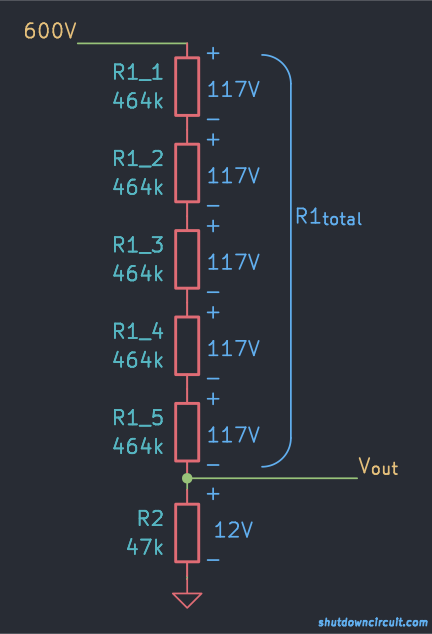
The resistors that make up R1 must all be equal value. If mixed values are used, the voltage drop will not be uniform and may exceed the individual rating of one or more segments.
Worked example - 600 V TS bus to 12 V analogue signal:
Target: = 600 V, = 12 V, 1206 package resistors (200 V max, 250 mW rated).
-
Choose R2 = 47 kΩ.
-
From the divider formula, .
Use
-
Voltage across and quiescent current
-
Voltage constraint (200 V per 1206): minimum segments =
Minimum is very nearly a whole number. Choose four resistors for safety.
-
Power constraint (250 mW per 1206): power per segment = per segment. Well below 250mW
-
Use 5 × 464 kΩ 1206 in series (= 2.32 MΩ) for Voltage derating margin (component quality, creepage due to impurities on board etc):
- Voltage per resistor: -> 40% safety factor for 1206 resistors
- Power per resistor:
We built in two resistors worth of safety factor in R1 for this design. We added one because the minimum segements was very close to a whole number (2.94 resistors required) and another to account for other factors like impurities building up on the PCB, component quality, transient voltages that may appear on the HV bus etc. We want this part of the circuit to be absolutely bullet-proof - any high-current failure mode here will simply vaporise the PCB traces.
This solution could be optimised for lower impedance by eg. reducing and re-solving for low voltages and power in
It ought to be fine for input into eg. a comparator which has a very high input impedance.
Package voltage and power ratings (common SMD resistors):
| Package | Max working voltage | Typical power rating |
|---|---|---|
| 0402 | 50 V | 63 mW |
| 0603 | 75 V | 100 mW |
| 0805 | 150 V | 125 mW |
| 1206 | 200 V | 250 mW |
Gotchas
- A voltage divider when used as a reference voltage is is only ever as accurate as its supply voltage - regardless of resistor tolerance. If the supply voltage is not stable, or subject to noise, consider a different option: Voltage References exist as a dedicated part - they are usually a high accuracy zener diode shunt regulator and can have fantastic stability.
- A voltage divider is a weak driver. Connecting a low-impedance load directly to the output will pull the output voltage down. The output voltage formula assumes negligible load current relative to the divider current. If in doubt, buffer the output with a unity-gain op-amp.
- High-voltage dividers can carry some real quiescent current. In the 600 V example above, the divider draws a small continuout current. Across a 600 V source this is ~2 W of always-on dissipation. This may be unacceptable in a low-power or sleep-mode design - consider switching the divider via a high-side switch if it only needs to measure periodically.
- Resistor self-heating shifts resistance slightly and introduces measurement error. In high-voltage dividers where resistors are operating near their thermal limit, this temperature coefficient effect can be significant. Use resistors with a low TCR (≤ 100 ppm/°C) for measurement-grade dividers.
- Stray capacitance across R2 or the PCB trace to the output node creates a low-pass filter with time constant τ = (R1 ∥ R2) × C_stray. For slow DC measurements this is harmless. For AC or fast transient measurements, keep traces short and shield sensitive nodes.